Some Arabic sounds have no match in English or Malay. ع, ق and ض feel strange in the mouth at first, and that is normal. Many of us learned to recite by copying the people around us, and small slips settled in years before anyone pointed them out.
Struggling with these sounds is not failing. The Prophet ﷺ said that the one who recites the Quran with difficulty, stumbling over the words, receives two rewards (Sahih Muslim 798). Your effort counts even while your recitation is still a work in progress.
This guide shows you how to improve Quran pronunciation one small step at a time. We wrote it for non-Arabic speakers, especially parents learning alongside their children. If you start now, you have about four months before Ramadan 1448H. The Islamic calendar from Majlis Ugama Islam Singapura (MUIS) lists the first day of Ramadan as Monday, 8 February 2027. That is enough time to hear a real difference in your Al-Fatihah.
The four steps at a glance:
- Get each Arabic letter right. One wrong letter can change the meaning of a word.
- Listen to a slow reciter, then record yourself and compare the two.
- Learn one Tajweed rule a week, using the colours in a Tajweed Quran.
- Practise 15 minutes a day and see a qualified teacher every week or two.
Why Improving Quran pronunciation feels hard for non-Arabic speakers
Quran pronunciation is the skill of making each Arabic sound from its proper place in the mouth. Understanding the meaning is a separate skill, which we cover in our guide to reading the Quran without knowing Arabic.
English and Malay have no true match for letters like ع, ح, ق and ض. So your tongue reaches for the nearest sound it already knows. That is how qalb (heart) slips into kalb (dog).
A University of Malaya study of Malay and African reciters found that non-Arabic speakers struggled more with fluency and Tajweed rules. A 2015 study of Malaysian university students named the seven letters that gave them the most trouble: ح, ع, ق, ث, ض, خ and ص. If those letters trip you up too, you are far from alone.
Before you fix anything, find out which sounds catch you. Recite Surah Al-Fatihah aloud once and record it on your phone. Circle every word where your mouth felt unsure. For many beginners, that is al-'alamin (with its ع), ar-Rahman (with its ح) or wa lad-dallin (with its ض). Those circled words are your starting list for Step 1.
Step 1: Get each Arabic letter right before anything else
Makharij al-huruf is the Tajweed term for the exit points of the Arabic letters. It means the exact spot in your throat, tongue, lips or nose where each sound begins.
Tajweed teachers group these exit points into five areas. They are the space inside the mouth and throat, the throat itself, the tongue, the lips and the nose. Once you know where a letter comes from, you stop guessing.
Letters carry meaning. Say عليم ('alim) with a proper ع from the middle of the throat, and you call Allah the All-Knowing. Let it slide into a plain "a", and it becomes أليم (alim), the Quran's word for a painful punishment. Fixing one letter this week is far easier than carrying the same slip through every salah for years.
Pick one contrast pair a day from the list below. Sit in front of a mirror and say each letter slowly ten times on its own, then ten times inside its word. Record the pair and play it beside a reciter saying the same word. Move on only when your own ear can hear the difference.
- ق / ك: qalb (heart) vs kalb (dog). ق comes from the back of the tongue, near the throat. ك sits a little further forward.
- ع / أ: 'alim (All-Knowing) vs alim (painful). ع tightens the middle of the throat. أ is a light catch at the top.
- ص / س: صيف sayf (summer) vs سيف sayf (sword). ص is heavy, with the back of the tongue raised. س stays light.
- ط / ت: طين tin (clay) vs تين tin (fig, the name of Surah 95). The same heavy and light pattern.
- ث / س: For ث, rest the tip of your tongue between your teeth, like the "th" in "think". س is a plain "s".
If wa lad-dallin was on your list, give ض a whole week of its own. Press the side of your tongue against your upper back teeth and let the sound come out heavy. Arabic is so tied to this letter that people nickname it lughat ad-dad, "the language of the ض".
If the alphabet itself is still new to you, the Iqra books in English and Malay teach each letter with a phonic method. Malaysian primary schools use the series, so it suits parents and children learning side by side.
The drill is working when qalb and kalb sound like two different words on your own recording. Then it's time to train your ear.
Step 2: Listen to a slow reciter, then record yourself
Murattal is the slow, measured style of Quran recitation. Every letter gets its full shape, and the reciter never rushes.
Your mouth can only copy sounds your ear has heard clearly. That is why SeekersGuidance teachers point learners to the murattal recordings of Sheikh Mahmoud Khalil Al-Husary as their main model. Sheikh Muhammad Siddiq Al-Minshawi is a strong second choice. You can listen to Al-Husary's full recitation free on Quran.com.
Recite out loud, never silently in your head. No one, including you, can correct a sound you only imagine.
Your first playback may surprise you. You hear your own voice partly through the bones of your head. Only a recording lets you hear the voice everyone else hears.
Choose one short surah. Play Al-Husary once while you follow the text, then record yourself at the same slow pace. Play both back to back, write down one difference, and re-record. Stop for the day once that difference is gone.
Here is what that looks like with Surah Al-Ikhlas, which has four short verses:
- Listen to Al-Husary recite qul huwa Allahu ahad.
- Record your own version.
- Compare only the ح in ahad (أحد). Is it a breathy ح from the middle of the throat, or has it softened into an English "h"? This is the same letter work from Step 1, now inside a real verse.
- Re-record until your ح matches his, and leave the rest for tomorrow.
Once Al-Ikhlas sounds right, move on to the other short surahs. Our beginner's guide to Juz Amma suggests where to go next.
A good sign of progress is catching a mistake on playback before you compare it with the reciter. At that point your ear is ready to see those sounds marked on the page.
Step 3: Learn Tajweed rules one at a time with a colour-coded Quran
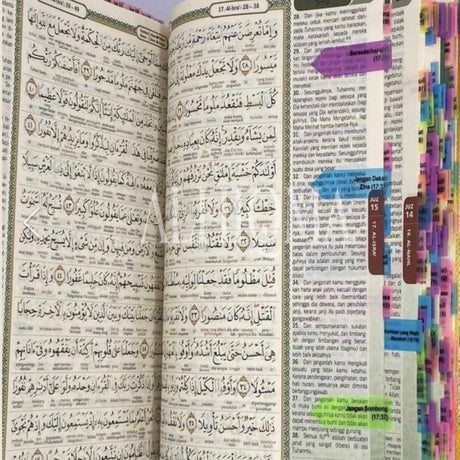
Tajweed is the set of rules that tells you how long, how softly and from where to make each sound. A colour-coded Tajweed Quran prints those rules onto the Arabic text, so you can see them as you read.
If you try to learn every rule at once, you end up with a head full of terms and nothing you can use. One rule a week is easier to remember.
Colour does part of the remembering for you. In the Dar Al Maarifah Tajweed Quran, red marks a stretched vowel (Madd) and green a nasal hum (Ghunnah). Blue marks a Qalqalah echo, and grey a silent letter. Your eye catches the rule before your tongue reaches the word. Each publisher uses its own colour key, so check the guide at the front of your copy.
Transliteration helps in the early weeks, but it has limits. Roman letters write ع and أ as the same "a", and they can't show a heavy ص next to a light س. That's why the 'alim and alim mix-up from Step 1 is so easy to make.
Learn one rule a week, in the order below, using the short surahs you recorded in Step 2. In each session, find that week's colour on the page. Recite only those words and record them once.
Here is a five-week plan for Tajweed for beginners:
- Week 1, Madd (red): Hold the vowel in maaliki (Al-Fatihah) for two even counts. Tap your finger to keep time.
- Week 2, Ghunnah (green): Hum the doubled noon in inna (إِنَّ) through your nose for two counts.
- Week 3, Qalqalah (blue): Let the د bounce lightly when you stop on ahad, as-samad and lam yalid in Al-Ikhlas.
- Week 4, Noon Sakinah and Tanween: There are four rules (Izhar, Idgham, Iqlab and Ikhfa). Start with Iqlab, the easiest to hear: you read min ba'di as mim ba'di, because the ن turns into a م before ب.
- Week 5, Waqf (stopping): Learn two signs first. A small م above the text means you must stop. لا tells you not to stop.
Not sure whether you need Tajweed colours or transliteration? This side-by-side comparison of Tajweed and transliteration Qurans will help. If you still lean on Roman letters, here's how to use transliteration as a short-term bridge.
For a first copy, the Dar Al Maarifah edition (S$33) pairs the colours with transliteration. The Noble Tajweed Quran adds the full Hilali and Muhsin Khan English translation. If you prefer larger print, Al-Quran Al-Karim Al Mujawwad is A4 and marks where to stop and start.
By week five, you should be adjusting your voice when you see a coloured letter, without stopping to think. What keeps the rules from fading is a short daily routine and a teacher.
Step 4: Build a 15-minute daily routine and get a teacher's ear
A daily Quran reading practice for pronunciation is a short, fixed session where you work on one sound or rule at a time. Regular check-ins with a teacher catch the mistakes you can't hear.
The Prophet ﷺ said, "the most beloved deed to Allah is the most regular and constant even if it were little" Sahih al-Bukhari 6464. So 15 minutes after Fajr every day will do more for you than two hours squeezed into a Sunday.
Tie practice to something you already do, like the quiet minutes after dawn prayer or the last thing before bed. Then you never have to decide when to recite, and the habit survives busy weeks.
Shaykh Faraz Rabbani's first advice for better pronunciation is simple: recite slowly. One correct verse is worth more than a page full of errors.
Split your 15 minutes into four short blocks, and use the same short surah until it sounds clean:
| Time | What to do |
|---|---|
| 2 minutes | Listen to Al-Husary recite Surah Al-Ikhlas |
| 5 minutes | Drill this week's letter pair or Tajweed colour |
| 5 minutes | Recite the surah aloud and record it |
| 3 minutes | Play it back and write down one fix for tomorrow |
Whatever you fix in the morning, recite in your next salah, so you use the correction several times that day. If you want to polish the other parts of your prayer as well, go through what to recite during salah.
When your list of mistakes grows, fix them in this order:
- Errors that change a letter or vowel. Scholars call these lahn jali, clear errors, and they come first because they can change the meaning.
- Finer Tajweed details, such as Ghunnah or Madd length. These are lahn khafi, hidden errors.
- Flow and pace.
Hold off on memorising new surahs until a passage sounds right, or you'll lock in old mistakes. Once Al-Ikhlas is clean, work through the rest of Juz Amma in order.
Your recordings will catch a lot, but a teacher hears what your ear still misses. One session a week, or every two weeks, is enough. In Singapore, MUIS requires every Quran teacher to hold recognition under the Asatizah Recognition Scheme (ARS). Many mosques run adult classes, from basic Iqra to Tajweed, under the QuranSG initiative.
Before each session, ask Allah for steadiness with a short dua, like this dua for staying consistent with the Quran.
Over the weeks, your teacher's corrections should get shorter.
Frequently asked questions
Can I improve my Quran pronunciation without a teacher?
Yes, you can make real progress on your own. Recording yourself and comparing it with a slow reciter will fix many letter mistakes. Still, Shaykh Faraz Rabbani advises learners to find a teacher, because some errors are invisible to your own ear. Practise alone during the week, and let a teacher check you every week or two.
Is my salah valid if I mispronounce Al-Fatihah?
Ustadha Shazia Ahmad of SeekersGuidance answers this from the Shafi'i school. A mispronunciation does not invalidate the prayer unless it changes the meaning and you did it on purpose read the full answer. She adds that you should keep learning and do your best, ideally with a Tajweed teacher. Rulings differ in detail between schools, so ask your own teacher or ustaz about your situation.
Is learning Tajweed compulsory?
A SeekersGuidance answer, checked by Shaykh Faraz Rabbani, says every Muslim must pronounce the letters correctly. That means avoiding major errors, such as swapping, adding or dropping letters. The answer calls minor errors in the finer rules disliked, not sinful. Studying Tajweed as a science is a communal duty, so not everyone has to master its theory.
Is it sinful to make mistakes while I'm still learning?
A sincere learner is not blamed for honest slips. Ustadh Tabraze Azam reminds worried reciters that Allah does not burden anyone beyond what they can bear. The promise of two rewards for the one who recites with difficulty also applies to you (Sahih Muslim 798). Keep reciting, and keep correcting.
Which reciter should beginners listen to?
Start with Sheikh Mahmoud Khalil Al-Husary. His murattal recordings are slow and clear enough to follow word by word, and you can listen to him free on Quran.com. Sheikh Muhammad Siddiq Al-Minshawi is a good second choice. Pick one and stay with him for a month, so your ear has a single, steady model.
Can I learn Quran pronunciation from YouTube or apps?
They are useful for listening and for checking colours on the page. But a video can't hear you, and an app can miss what a trained ear catches. Use them between lessons with a teacher.
Can I rely on transliteration instead of the Arabic script?
Treat it as a temporary bridge to the Arabic script. Roman and Rumi letters can't show the difference between ع and أ, or between heavy and light letters, so some mistakes stay hidden. Unsure which system suits you? See how Roman and Rumi transliteration differ, or browse the transliteration Qurans we recommend for beginners in Singapore.
I grew up reading Rumi. Where should I start?
Keep your Rumi Quran for meaning and confidence, and learn the Arabic letters in parallel. A Malay translation Quran with Rumi transliteration shows the Arabic and the Rumi side by side. You will spot where the two don't match.
How do I pronounce ض?
Press the side of your tongue against your upper back teeth and push the sound out heavy, with the back of the tongue raised. It should not sound like an English "d" or a "z". Because ض is so hard to describe in writing, ask a teacher to show you in person.
I'm an adult and feel shy about joining a class. Where can I learn in Singapore?
Many Singapore mosques run classes for adults only, from basic Iqra to Tajweed and talaqqi (reciting directly to a teacher). Some also offer them online. The QuranSG directory lists programmes by mosque and district. Plenty of adults start at the basic level, and nobody expects you to be perfect.
What's the difference between an ARS-recognised teacher and an Ijazah?
MUIS requires ARS recognition before anyone can teach the Quran in Singapore. An Ijazah is a certificate from a teacher confirming that a student recites correctly, usually with a chain of teachers going back generations. For classes in Singapore, check ARS recognition first.
How can I help my child pronounce the Quran correctly?
Start with letters, not whole surahs. The Iqra phonic series targets children aged four to seven and teaches one sound at a time. Sit together for ten minutes a day and practise the letters. When your child hears you correct your own mistakes, they learn that slips are part of learning.
Should I learn Arabic as a language first?
No. Reciting and understanding are separate skills, and you can start reciting correctly today. You can read more in our guide to reciting the Quran without speaking Arabic.
How long does it take to improve?
It depends on where you start and how regularly you practise. Letter sounds often settle faster than Tajweed rules, which is why the five-week plan in Step 3 takes one rule a week. Daily practice matters more than total hours.
Start improving your Quran pronunciation tomorrow
You don't need to fix everything at once. Good Quran pronunciation for beginners comes from small corrections repeated over weeks, one letter or one rule at a time.
Tomorrow after Fajr, record yourself reciting Surah Al-Fatihah. Play it back once and circle the single word that sounded least sure. That word is where you start.
Keep that recording. In a few weeks, record Al-Fatihah again and play the two side by side. Hearing how far you've come is what keeps a daily Quran reading practice going.
To keep track, download our free printable Quran Pronunciation Checklist and pin it beside your prayer mat.
If you'd like the rules printed on the page, take a look at our colour-coded Tajweed Qurans. Once your recitation feels steady, you can start reflecting on what you recite with our step-by-step guide to tadabbur.
Allah rewards every effort you make here, including the stumbles along the way.