If you've ever second-guessed a word while reading Quran transliteration — wondering if you said it "close enough" — you're not alone. Transliteration is a useful bridge for beginners who can't yet read Arabic script. But it comes with blind spots that shape how you sound, without you ever noticing.
This post walks through the 7 most common Quran transliteration mistakes: why they happen, and how to fix them. None of these mistakes mean you're reading wrong on purpose. They mean transliteration was never designed to carry everything Arabic pronunciation needs. Once you see where the gaps are, closing them is straightforward.
The 7 mistakes at a glance:
- Confusing Ha (ه) and Ha (ح)
- Flattening 'Ayn (ع) into Alif (ا)
- Mixing up Seen (س) and Saad (ص)
- Inconsistent Madd (elongation) counts
- Skipping Ghunnah and Idgham rules
- Relying on transliteration alone, with no audio check
- Rushing through verses instead of reading slowly
Why Transliteration Mistakes Happen — and How to Close the Gaps
Common transliteration mistakes in Quran reading happen because Roman letters were never built to carry every Arabic sound. One "h" or "s" ends up standing in for two or three different letters.
Most beginners aren't taught this gap outright. They read the transliteration as printed and assume it's complete. That's why Quran transliteration mistakes rarely feel like mistakes at first. This is especially true for readers still deciding Can You Read the Quran Without Knowing Arabic? and leaning on transliteration as their main bridge. The brain locks onto whatever version it hears repeated most, whether that's a teacher's correction or a self-taught guess. That's why catching pronunciation mistakes early beats reading fast.
Learning to read Quran transliteration starts with one small shift: read a line, then listen to a verified reciter say the same line. Notice where your mouth moved differently. If a word contains "ha," check whether your edition marks the soft ه or the throaty ح. That single letter can change both sound and meaning.
Catch that one gap between reading and hearing, and the rest gets much easier to fix. Start with the letters people confuse most.
Letter and Sound Mix-Ups (Mistakes 1–3)
The most common transliteration mistakes in Quran reading start at the letter level, where two or three distinct Arabic sounds get flattened into one English spelling.
English doesn't have a slot for every Arabic sound, so publishers make a judgment call and readers inherit it without realizing anything was lost. It's easy to see why: once your eyes see "h" or "s" on the page, your brain defaults to the version it already knows — even when the letter is something else entirely. That's how a single missed distinction can repeat itself across an entire reading session, especially in editions like Roman vs Rumi Quran Transliteration Explained, where systems don't agree on how to mark the same letter.
Mistake 1: Ha (ه) vs. Ha (ح)
Both often transliterate as "h." But ه is a light, breathy sound, while ح comes from deep in the throat. Treating them as identical is one of the most common Quran pronunciation mistakes beginners make.
Mistake 2: 'Ayn (ع) vs. Alif (ا)
'Ayn has no real English equivalent: it's a voiced sound produced from the throat. Yet many readers flatten it into the simple glottal "a" of Alif.
Mistake 3: Seen (س) vs. Saad (ص)
This one changes meaning, not just sound. "Sabar" with a seen means small rocks. "Sabar" with a saad means patience (as-sabr). Same spelling in transliteration, entirely different word. Editions such as Abdullah Yusuf Ali print the Arabic script alongside the transliteration so readers can double-check tricky letters. For a deeper academic reference on how individual Arabic letters map to sound and meaning, the Quranic Arabic Corpus offers a free word-by-word breakdown.
The fix is simple: check the Arabic script beside any word containing "h," "a," or "s" in transliteration. Confirm the letter before you say it out loud.
Getting this right means the words you recite carry their true sound and their true meaning, instead of a close guess that happens to look right on the page. Next up: the mistakes that aren't about letters at all. They're about rhythm.
Rhythm and Elongation Mistakes (Mistakes 4–5)
Beyond individual letters, some of the most common Quran transliteration mistakes happen in rhythm. That means how long a sound is held, and whether it merges into the next letter.
This is easy to miss because transliteration text is flat. It shows you the sound, but not how long to hold it, or when to blend it into what comes next. Without a visual cue, the brain defaults to whatever feels natural in the moment. Read the same word twice, and it can sound different each time. That's why Tajweed Quran vs Transliteration Quran exist as separate systems. Transliteration tells you what to say. Tajweed — the rules for correct Quranic pronunciation — tells you how.
Mistake 4: Inconsistent Madd (elongation)
A "two-count" vowel should be held for roughly the same length every time. But many self-taught readers stretch it for one count in one verse and four counts in the next, because transliteration doesn't mark the count.
Mistake 5: Skipping Ghunnah and Idgham
Nasal sounds (Ghunnah) and letter-merging rules (Idgham) shape how words connect. Since plain transliteration can't show either one, readers often pronounce each letter separately instead of blending them as the rules require.
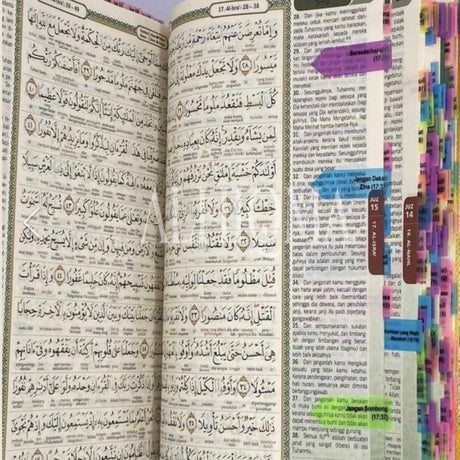
The fix is simple: choose an edition with colour-coded Tajweed markings, so elongation and merging rules are visible on the page instead of guessed. The Tajweed Quran with English Translation & Transliteration by Dar Al Maarifah is one option.
Get this right, and your recitation gains a natural, consistent flow. That's the difference between reading words and reciting them out loud. From here, the last two mistakes aren't about letters or rhythm, but about the habits built around how you practice.
Habit Mistakes That Slow Progress (Mistakes 6–7)
The last two common Quran transliteration mistakes have nothing to do with letters or rhythm. They're about the daily habits behind your practice.
This category is easy to overlook because these errors don't feel like mistakes at all. They feel like reasonable workarounds. Reading silently is easier than finding audio, and moving fast feels more productive than moving slow. So the brain quietly chooses the path of least resistance, even when it works against progress. Over weeks and months, these small shortcuts compound into habits that are far harder to unlearn than a single mispronounced letter.
Mistake 6: Relying on transliteration alone
Treating the printed transliteration as the finished product, without ever listening to a verified reciter say the same verse, leaves you with zero feedback loop. There's no way to know if what's in your head matches what's correct.
Mistake 7: Rushing through verses
Moving quickly to "finish" a page, instead of reading a few verses carefully, means every letter and rhythm mistake gets repeated at speed. Nothing gets corrected early.
The fix is simple: read one verse, play a short recitation of it, and only move on once your version matches. It's a five-minute habit that catches these mistakes before they take hold. It's similar to the structured pacing in the Free 30-Day Khatam Quran Checklist.
Build this habit, and progress becomes permanent instead of fragile. With all seven mistakes on the table, the last step is choosing an edition and routine that makes avoiding them effortless. We'll walk through that next.
How to Fix These Mistakes and Choose the Right Quran
Fixing these seven Quran transliteration mistakes ultimately comes down to one thing: choosing an edition that shows you what plain transliteration can't.
Most reading mistakes don't survive contact with the right tools. Once a letter, a Madd count, or a Ghunnah rule is marked on the page, guessing stops being necessary. When something's hard to check, people give up checking. That's why the right edition beats willpower for accuracy. Choosing well upfront means you're not fighting the same seven mistakes for months.
Start by matching the edition to where you are right now. If letter confusion (Mistakes 1–3) is your main struggle, look for a Quran with Arabic script beside the transliteration. The Abdullah Yusuf Ali edition and the Al-Quran Noble by Dr. Muhsin Khan both fit the bill. If rhythm and elongation (Mistakes 4–5) are the issue, a colour-coded option like theTajweed Quran with English Translation & Transliteration by Dar Al Maarifah marks Madd and Ghunnah rules directly on the page.
Get the edition right, and the daily habit of accurate reading stops feeling like effort. It becomes the natural next step toward reading with real confidence, not just familiarity.
If you're still weighing which edition fits your level best, Best Quran Transliteration for Beginners in Singapore breaks down the options in more detail.
Seven mistakes, one root cause: transliteration shows you a close approximation, not the full picture, and small gaps compound if they go unchecked. Every one of them is fixable with the right edition and a few minutes of deliberate practice each day. You don't need perfect Arabic to start reading more accurately. You just need to know what to look for. Now you do.
Want this to become a daily rhythm, not a one-time read? Grab the Free 30-Day Khatam Quran Checklist. It paces your reading so you catch mistakes early instead of repeating them for a month straight.
Frequently Asked Questions
How do I know if my transliteration edition is trustworthy?
Look for three things: Arabic script printed alongside the transliteration, a named translator or publisher you can verify, and consistency in how the same letter is transliterated throughout the book. An edition that shows its sources earns trust the moment you can double-check it yourself, rather than asking you to take accuracy on faith. Editions like the Al-Quran Noble by Dr. Muhsin Khan meet this bar, since the scholarship behind them is documented and consistent page to page.
Does mispronouncing a word while learning mean I'm doing something wrong?
No. Sincere effort while learning is not the same as carelessness. Anxiety about "getting it wrong" is often what causes rushing (Mistake 7) in the first place, so easing that fear is itself part of the fix. For specific questions about how mistakes affect recitation or prayer, ask a knowledgeable teacher or local scholar, not general online guidance. Knowing this, you can slow down and self-correct without guilt. That's the exact habit that prevents these mistakes from becoming permanent.
How long does it take to move from transliteration to reading Arabic script directly?
There's no fixed timeline. It depends on practice consistency, not talent. Most self-taught readers who practice daily start recognizing basic Arabic letters within a few months. The shift happens gradually: transliteration becomes a backup you check less often, rather than the text you read first. Start small: learn five to ten Arabic letters a week alongside your normal transliteration reading. The switch happens without ever feeling like starting over. For a fuller roadmap on this transition, see Can You Read the Quran Without Knowing Arabic?