Both promise to help you read the Quran without Arabic fluency. But Roman and Rumi transliteration are built for two different readers. Pick the wrong one, and the edition ends up gathering dust on a shelf. This guide builds on our Quran Transliteration: A Beginner's Guide.
Roman vs Rumi - what's actually the difference?
Roman Quran transliteration spells out the Arabic sounds using English spelling. Rumi Quran transliteration spells out the same sounds using Malay spelling. Same Arabic, two different alphabets doing the sounding-out.
Psychologists call this processing fluency. Your brain reads faster when letters match sounds it already knows by instinct. It slows down when it has to decode something new.
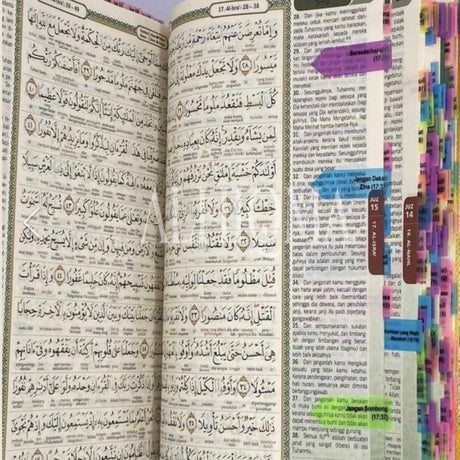
A Roman English transliteration Quran, like the Abdullah Yusuf Ali Roman English Transliteration Quran, spells the opening verse "Bismillahir Rahmanir Raheem." It doubles vowels the way English readers expect.
A Malay Rumi transliteration Quran, like the Al-Quran Ar-Rumi, spells the same phrase "Bismillahir Rahmanir Rahim." It follows Malay spelling rules instead. Neither is more "correct." Each is built for a different reader.
Here's a quick test: open one line each of a Roman and a Rumi edition. Read both out loud. Which one did you say without pausing to sound out a word? That's your script. For most Malay-speaking Singaporeans, it's Rumi. For most English-first readers, it's Roman.
Once you read in your own script, unfamiliar surahs stop feeling like decoding. They start feeling like reading. That's why the differences below matter more than they first appear.
Side-by-side comparison: Roman vs Rumi
Roman and Rumi editions differ beyond spelling. They differ in layout, in which translation they pair with, and in who publishes them.
Roman English transliteration editions almost always pair with an English translation. They're built for readers who think and pray in English. Malay Rumi transliteration editions pair with a Malay translation. They're built for readers who think in Bahasa. This pairing matters as much as the transliteration itself. Your brain reads translation faster when a familiar script sits right beside it. Mismatch the pairing, say, Rumi letters next to an English translation, and you'll slow down without knowing why.
Place a Roman edition and a Rumi edition side by side. Open both to Surah Al-Ikhlas. Watch how your eyes drop to the translation column. That instinctive drop is your answer.
| Edition type | Pairs with | Suits |
|---|---|---|
| Roman transliteration | English translation, e.g. Holy Quran by Abdullah Yusuf Ali | English-first readers |
| Rumi transliteration | Malay translation, e.g. Al-Quran Ar-Rumi | Malay-first readers |
Get this pairing right once. Every page you open after that reads as one smooth line, not three scripts fighting for your attention. The next question isn't which is better. It's which one fits your household.
Which one should you choose?
Pick the edition that matches your dominant reading language. Not your ethnicity. Not your community. Not which one "sounds" more Islamic.
We trust what looks familiar. A Malay-Singaporean who reads and thinks in English can still feel a flicker of guilt picking a Roman edition over a Rumi one. But the right choice isn't the one that matches your background. It's the one you'll open again tomorrow. Bilingual households often keep one of each instead of forcing a single answer.
Think about the last thing you read for fun. A novel. A news article. A message from a friend. Notice the language. If it was English, start with a Roman English transliteration Quran like the Holy Quran by Abdullah Yusuf Ali. If it was Malay, start with a Malay Rumi transliteration Quran like the Al-Quran Malay Rumi Transliteration. Want to see how transliteration relates to meaning once you've picked a lane? Read Quran Transliteration vs Translation: Key Differences.
Get this one decision right. You remove the biggest reason beginner Qurans sit unopened on a shelf. Reaching for it will feel effortless, not like homework. If you're still weighing whether transliteration is a legitimate place to start at all, our guide on Can You Read the Quran Without Knowing Arabic? answers that directly.
Common misunderstandings about Rumi transliteration
Many people think Rumi Quran transliteration is a "lesser" or less rigorous option than Roman. It isn't. It's built for a different reader, full stop.
This idea comes from a simple bias: English carries an unearned sense of formality. It's more visible in official settings. That can make a Rumi edition feel less "proper," even though both scripts do the same job. Both represent Arabic sound. Religious guidance on transliteration backs this up. The Federal Territories Mufti Office of Malaysia's ruling on Romanised letters¹ treats accurate pronunciation as the real concern. The script used doesn't change that concern. The ruling speaks to Romanised letters directly. If you want the same question answered for Rumi, ask a local asatizah. One thing is clear either way: publishing volume and regional preference explain why Rumi editions are less common on shelves. Religious standing has nothing to do with it.
Catch yourself thinking a Rumi edition is the "backup" choice? Read one verse in Rumi. Picture explaining its meaning to your child right after. If the explanation comes easily, and you weren't translating from English first in your head, that discomfort was familiarity. Not accuracy.
Let go of that assumption. Pick the edition you'll keep reading. That matters more than which script it uses.
Picking your first Roman or Rumi edition
Picking your first transliteration Quran comes down to one decision. Pair your script, Roman or Rumi, with a beginner-friendly layout. Stop there.
This is where decision fatigue derails people. Psychologists call it choice overload. Compare more editions, and you feel less confident about any single pick, even when several would work fine. Don't chase the perfect edition. Pick a good-enough one. Build a reading habit first. The format matters less than you think. A few weeks of daily reading will teach you more about layout than any amount of pre-purchase comparison.
The method is simple. If English is your everyday language, start with the Holy Quran - Roman English Transliteration & Translation by Abdullah Yusuf Ali. If Malay is your everyday language, reach for the Al-Quran Ar-Rumi, Malay Translation & Rumi Transliteration instead. Either way, browse the full Malay Rumi Transliteration Quran Collection. Compare covers and sizes within one lane, not across both scripts.
Make this one choice. Stop shopping for the "right" one. Tonight, you'll be reading the Quran, not still deciding which copy deserves to be opened first.
Frequently asked questions
Is Rumi transliteration only for Malaysians, or can Singaporean Muslims use it too?
Rumi Quran transliteration follows Malay spelling, not Malaysian nationality. Any Malay-speaking reader in Singapore benefits the same way. Many Malay-Singaporean families default to it for this reason. Think in Malay day to day? A Malay Rumi Transliteration Quran will likely feel more natural than a Roman edition.
Can I switch from Roman to Rumi (or vice versa) later without losing progress?
Yes. Both are transliteration systems built on the same Arabic. Switching scripts won't reset your reading progress. Only your spelling comfort resets, and only briefly. Beginners who go on to learn Arabic script find the switch even smaller. Neither Roman nor Rumi was ever meant to be permanent. See Can You Read the Quran Without Knowing Arabic? for how that shift works.
My family speaks both English and Malay at home. Do I need both editions?
Not always. But many bilingual households keep one of each. That way, every reader picks up the copy that matches their instinct. Start with whichever language you read fastest. Add the second edition only if someone else in the household needs it.
Does choosing Rumi over Roman (or vice versa) affect how the Quran translation reads?
No. The script and the translation are separate layers. What matters more: pair your transliteration with a translation in the same language. A mismatched pairing is what slows readers down. Compare this with translation choice in Quran Transliteration vs Translation: Key Differences.
Whichever script you land on, the win isn't picking the "better" one. It's picking the one you'll keep opening.
1. Irsyad al-Fatwa Series 172: The Ruling of Using Romanised Letters to Write the Quran, Federal Territories Mufti Office of Malaysia.