What's the Real Difference Between the Two?
Tajweed and transliteration solve two different problems: one tells you which sound to make, the other tells you how to shape it correctly.
Most people assume the two formats compete. They sit at different points on the same reading journey instead. Tackling both at once is what causes beginners to give up in the first week. Transliteration exists so a reader with zero Arabic script knowledge can still sound out words using Roman or Rumi letters. Reading "Bismillah" instead of the Arabic script itself is the clearest example. Tajweed colour-coding sits directly on the Arabic script instead, flagging pronunciation rules such as elongation, nasal sounds, and emphasis the moment your eye lands on the word.
Think of transliteration as learning a song's words phonetically, and Tajweed as the sheet music showing how each note should be held. If you can't yet sound out Quran transliteration at all, that's your starting point before Tajweed colours will mean anything. And if you're wondering whether transliteration is the same thing as translation, it isn't. One gives you sound, the other gives you meaning, as covered in Quran Transliteration vs Translation.
Get this distinction right, and you'll stop wasting money on the wrong edition. You'll start opening your Quran daily instead of leaving it on the shelf.
One thing worth flagging before you compare Tajweed Quran vs transliteration Quran side by side: the colours themselves aren't standardised across publishers. That's what we'll unpack next.
Is a Colour-Coded Tajweed Quran Religiously Permissible?
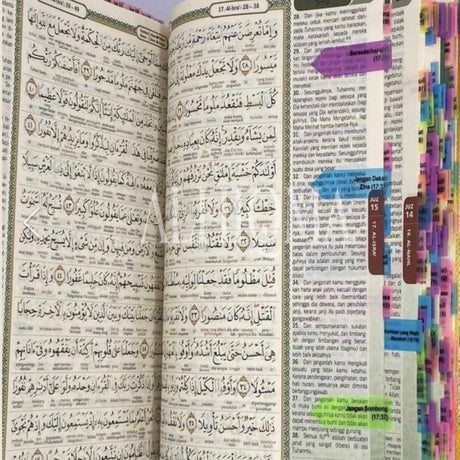
A colour-coded Tajweed Quran is simply a standard mushaf with pronunciation rules layered on in colour, and yes, it's permissible to use.
That guilt some readers feel about using a "modified" Quran is worth naming directly. It stops people from picking up a tool that actually helps them recite correctly. Darul Ifta Birmingham addressed this exact question and ruled that colour-coded Tajweed Qurans are permissible, comparing colour-coding to earlier additions like harakaat, the vowel marks added centuries ago to help non-Arab reciters read accurately. The underlying principle is Tarteel: reciting the Quran clearly and distinctly, not from memory of rules alone.
A Tajweed edition like the Dar Al Maarifah Tajweed Quran does exactly this. It helps you apply the rules as you read instead of memorising them ahead of time. That's the tool doing its job, not a shortcut to feel uneasy about.
The real payoff is confidence: you get to focus on connecting with the meaning instead of second-guessing every pronunciation.
Next, let's put both formats side by side so you can see where each one fits.
Side-by-Side: Tajweed Quran vs Transliteration Quran
Once you know both are permissible tools rather than competing "correct" choices, the real question becomes practical: which features match how you read.
| Feature | Transliteration Quran | Tajweed Quran |
|---|---|---|
| Script used | Roman or Rumi letters standing in for Arabic sounds | Original Arabic script, colour-coded |
| What it teaches | Which sound to make | How to shape and hold that sound |
| Best for | Readers with no Arabic script knowledge yet | Readers already comfortable reading Arabic script |
| Learning stage | Starting point | Refinement stage |
| Combined option | — | Dar Al Maarifah Tajweed Quran |
Most people freeze at this stage because of decision fatigue. A product page lists both features without explaining which one they need first. A transliteration-only edition suits someone who can't yet sound out Arabic letters at all. A Tajweed-only edition suits someone already comfortable reading Arabic script who wants to refine recitation accuracy. There's also a third option some readers overlook: a word-by-word translation edition, which pairs Arabic text with meaning rather than pronunciation. That's the right pick if your goal is understanding, not recitation practice.
Still not sure which camp you're in? Open any page and try to sound out three words from the Arabic script alone. If you can't, start with transliteration. If you can, Tajweed colours will mean something to you.
That combination is what settles the next question: which one should a true beginner start with.
Which Should Beginners Start With?
For a true beginner with no Arabic reading ability yet, the honest answer is transliteration first, Tajweed second.
Many new readers carry a quiet fear: that leaning on transliteration means they'll never actually learn Arabic. So they either avoid starting altogether, or jump straight to a Tajweed edition that leaves them stuck sounding out unfamiliar script. Treating transliteration as a bridge, not a final destination, removes that fear. A bridge is meant to be crossed, not lived on. Someone who prays Fajr and reads a page before the household wakes needs a format they can follow right away, not one that stalls them at the first line.
Start with a transliteration edition for a few weeks until the sounds feel familiar. Then bring in Tajweed colours once you're reading transliteration without hesitation. If you're still unsure whether you can begin at all without Arabic knowledge, our guide on reading Quran without knowing Arabic walks through that exact concern.
Follow this order and you build genuine reading confidence instead of guessing your way through both systems at once.
That confidence is what makes the final decision, matching the format to your specific goals, much easier.
How to Decide for Your Own Reading Goals
Once you understand the beginner sequence, match the format to what you're actually trying to do each time you open your Quran.
Ask yourself what today's reading session is for. A Quran mismatched to your goal is what causes highlighted pages to sit untouched. If you're reading aloud to practice recitation, a Tajweed edition earns its place. If you're reading for daily comprehension and haven't built up Arabic script fluency yet, transliteration keeps the habit alive. If you want both without switching editions, a combined format removes the choice entirely.
Run this quick check before buying: are you reciting out loud, or reading quietly to understand? Reciting aloud points to Tajweed. Reading quietly points to transliteration. Someone praying Fajr and reading one page before the household wakes might pick transliteration for speed, then add Tajweed later for accuracy.
Match the format to the goal and you'll actually use your Quran daily instead of leaving it on the shelf.
Browse the Tajweed Quran Collection or the combined Dar Al Maarifah Tajweed Quran edition to find the right fit for your reading goal today.
Frequently Asked Questions
Are Tajweed colours the same in every Quran?
No. Colour schemes vary by publisher, so always check the key printed at the front of your specific copy before assuming red means the same thing everywhere.
Can I switch from transliteration to Tajweed later, or do I need a new copy?
Most readers do switch, and it simply means picking up a second edition once you're ready. Some choose a combined copy like the Dar Al Maarifah Tajweed Quran from the start so there's nothing to switch at all.
Is it disrespectful to use a "modified" Tajweed Quran?
No. Colour-coded Tajweed editions have been ruled permissible, in the same way earlier vowel marks were added to help non-Arab reciters read correctly.
Do I need to memorise all the Tajweed rules if I use a colour-coded edition?
Not upfront. The colours let you apply the rules as you read, so memorising them becomes a gradual byproduct of practice rather than a prerequisite.
Does a Tajweed Quran cost more than a transliteration-only Quran?
Usually yes, since a Tajweed edition involves additional colour printing and often a larger page format for readability. A combined transliteration-and-Tajweed edition costs more than either alone, but saves you from buying two separate copies later.
Can children use a colour-coded Tajweed Quran?
Yes, and many parents introduce colour-coding early because children respond well to visual cues. Pair it with a size and script your child can already read comfortably, rather than starting with Tajweed alone before they can sound out words at all.
Is Tajweed colour-coding available with Malay Rumi transliteration?
At Al-Hiqma, Tajweed colour-coding is currently available in English and Roman transliteration editions. If Malay Rumi is your priority, browse the Malay Rumi Transliteration Collection, and consider adding a Tajweed edition alongside it once you're ready for that stage.
How long does it typically take to move from transliteration to Tajweed?
There's no fixed timeline. Most beginners feel comfortable with the sounds, and ready for Tajweed colours, after a few weeks of consistent daily reading.
If I misread a Tajweed rule, does that invalidate my recitation?
No. Learning is a process, and an honest mistake while practising doesn't invalidate your effort or your prayer. Tajweed colour-coding exists precisely to reduce these mistakes over time, not to punish you for making them while you learn.