What Is Quran Transliteration?
Quran transliteration writes out the Arabic sounds of the Quran using Roman or Rumi letters, so you can pronounce the words without first learning Arabic script.
Most beginners assume they need years of study before they can open a Quran at all. That's why copies sit unread on shelves. An alphabet you already read every day removes that barrier. The first attempt at a familiar surah can happen this week.
Open a Roman English edition, like the translation by Abdullah Yusuf Ali, and read a line the way it's spelled. "Bismillahir Rahmanir Raheem" sounds close to the Arabic before you've studied a single Arabic letter. Sound it out slowly against a recitation you already know from prayer, and the words start to line up on their own.
A locked book becomes something readable today. That's what makes it possible to read Quran without knowing Arabic, well before you understand how those Roman letters were built to represent Arabic sound.
How the System Works
Each Arabic sound pairs with a Roman or Rumi letter combination. Small marks, macrons and apostrophes, capture sounds that plain English spelling can't show on its own.
Arabic has sounds English doesn't. A long "a" written as "ā" tells you to hold the vowel rather than clip it, the same way a stretched note in recitation carries more weight than a short one. Beginners often worry a system built on approximation can't be trusted. It can: it's a consistent code, not a guess, and once you know the code, the pronunciation follows.
A macron over a vowel means hold that sound a beat longer. An apostrophe marks a brief catch in the throat, not a letter to skip. In "Ar-Rahmān," that macron over the final a is the difference between rushing the word and giving it the length it's meant to carry. Readers who want the fuller technical picture can check the Library of Congress's Arabic romanisation standard1.,the same convention most publishers draw from when setting these marks.
Once the marks make sense, transliteration works as a pronunciation guide, not decoration. That's useful for new Muslims and for parents reading alongside their children.
Who This Helps
New Muslims, parents reading with young children, and adults easing back into daily practice share the same starting problem: no Arabic fluency yet, and no time to wait for it.
A new Muslim often feels pressure to catch up overnight, as though real practice can't begin until Arabic is mastered. A parent reading with a child faces the same gap. In both cases, the fear isn't really about Arabic. It's about starting something and getting it visibly wrong in front of someone. Worth saying plainly: leaning on transliteration while you build toward Arabic isn't a shortcoming. Our guide on reading Quran without knowing Arabic walks through that question in full, including short surahs to start with and how to build a routine that sticks.
Start small. Five minutes a day on a single short surah, following the transliteration line by line until the shape of the words becomes familiar. Someone reading Al-Fatiha this way every morning after Fajr notices the words sticking within a week, before formal Arabic lessons would produce the same result. Pairing the text with a recorded recitation speeds this up, since hearing the correct sound alongside the spelling catches small errors before they turn into habits.
Choosing a Format: Roman, Rumi or Tajweed-Coded
Three formats cover most beginner needs. Picking between them usually comes down to one question: which language do you already think in?
| Format | Best for | Adds |
|---|---|---|
| Roman English transliteration | English-first readers | Straightforward Latin-alphabet spelling |
| Malay Rumi transliteration | Malay-first readers | Familiar Rumi spelling patterns |
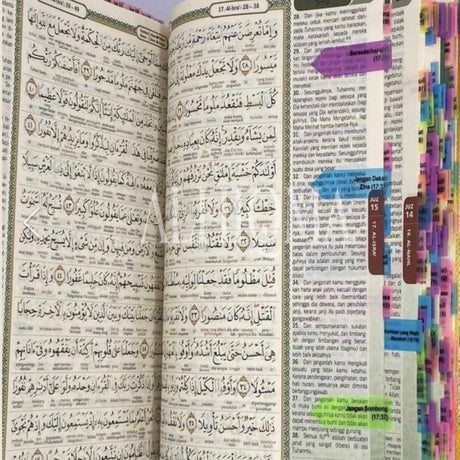
| Tajweed-coded transliteration | Either group, once the basics feel comfortable | Colour cues layered on top for pronunciation rules |
Too many options with no clear default stalls a first purchase. Matching the format to your first language, rather than the one that looks most authentic on a shelf, removes that stall. A Malay-speaking parent choosing the Malay Rumi transliteration collection over an English edition reads faster and corrects herself less, simply because the letter patterns already feel familiar.
Layering Tajweed colour-coding on top of either format adds a second signal once the basics are steady. Colour shows how to shape a sound. Transliteration shows which sound to shape. Readers weighing the Roman English side of that choice can browse the Roman English transliteration collection by Abdullah Yusuf Ali directly, including editions like the Noble Quran transliteration by Dr Muhammad Muhsin Khan.
Choosing Your First Edition
Size, script clarity and language pairing decide whether an edition gets opened daily or left on a shelf. An unused Quran carries a heavier kind of guilt than an unused gadget, which is part of why this decision feels harder than it should.
For bedside or on-the-go reading, a compact A6 Roman English transliteration edition works best. For desk or family study sessions, a larger A5 or A4 Tajweed Quran with English transliteration makes more sense. If you're undecided on your Arabic timeline, treat this first copy as a bridge rather than a permanent destination. The goal is building the daily habit that eventually leads toward the Arabic script itself.
Someone who prays Fajr, then reads a page before the household wakes, needs the pocket edition on the nightstand, not a heavy A4 copy stored across the room. Readers ready to sit with a passage rather than move quickly through it can follow that habit into our other blogs What Is Tadabbur?, Step-by-Step Guide to Engage in Tadabbur, and The Holy Quran in the Hands and Hearts of Everyone.
The next question is when you're ready to move from transliteration toward reading the Arabic script itself, a stage our guide on reading the Quran without knowing Arabic also touches on, since it covers what comes after transliteration as well as how to begin.
Frequently Asked Questions
Is reading Quran transliteration considered "really" reading the Quran?
Yes, in the sense that it lets you engage with the recitation and sound of the verses. It isn't a substitute for reading the Arabic script itself, and most teachers treat it as a bridge toward that goal.
Do I need a Tajweed edition to start, or is basic transliteration enough?
Basic transliteration is enough to begin. Tajweed colour-coding becomes more useful once you're comfortable with the sounds and want to refine pronunciation.
Is it wrong to rely on transliteration instead of learning Arabic?
No. Starting with transliteration while working toward Arabic fluency is a normal, common path.
Which transliteration edition should a beginner buy first?
Match it to your first language, Roman English if you think in English, Malay Rumi if you think in Malay, and pick a size you'll realistically carry or keep by your bedside.
1.The romanisation convention referenced in this article follows the Arabic Romanisation Table, developed jointly by the Library of Congress and the American Library Association's Committee on Cataloging: Asian and African Materials (CC:AAM), revised and approved November 15, 2012.